Amodei: No Open-Weights Ban—Chips, Distillation, and Testing Instead
Dario Amodei’s formal open-weights position rejects bans and pushes three tracks: chip export enforcement, industrial-scale distillation crackdown, and mandatory safety testing for capable open and closed models. Lands three days after the Nvidia-led letter that left OpenAI, Anthropic, and Google off the page.

This is Anthropic’s first full public answer to the charge that it wants open-weights banned for commercial protection. The durable signal is the three-measure stack—export controls, distillation, testing—not a categorical open/closed ideology.
Anthropic CEO Dario Amodei published “Our position on open-weights models,” stating flatly that Anthropic has never advocated a ban on open-weights models. The post answers speculation after reports of possible U.S. limits on Chinese open-weight models and the July 24 industry letter led by Nvidia, Microsoft, and Meta. Amodei instead backs three policy tracks: keep powerful chips and tooling out of authoritarian hands, crack down on industrial-scale distillation, and require mandatory safety testing for sufficiently capable models—open and closed.
What Anthropic says it supports#
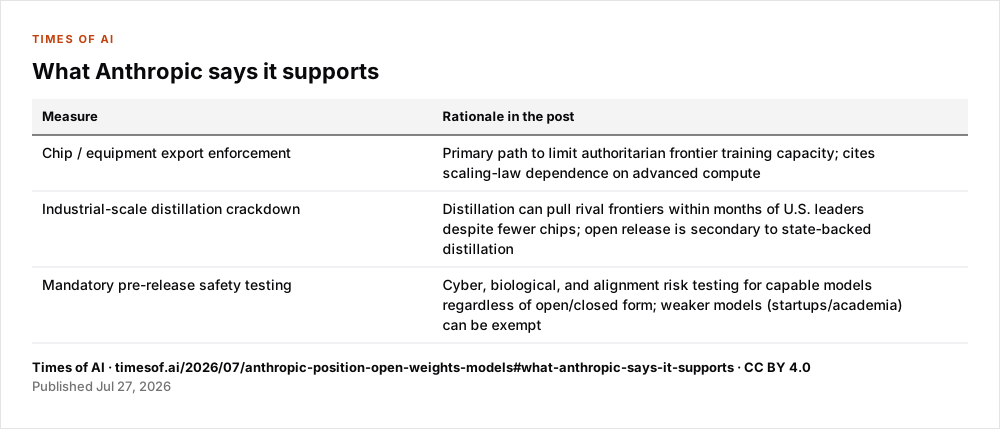
| Measure | Rationale in the post |
|---|---|
| Chip / equipment export enforcement | Primary path to limit authoritarian frontier training capacity; cites scaling-law dependence on advanced compute |
| Industrial-scale distillation crackdown | Distillation can pull rival frontiers within months of U.S. leaders despite fewer chips; open release is secondary to state-backed distillation |
| Mandatory pre-release safety testing | Cyber, biological, and alignment risk testing for capable models regardless of open/closed form; weaker models (startups/academia) can be exempt |
Open-weights models without dangerous capabilities are framed as a public good—low marginal cost to run, high value for businesses, developers, and researchers.
Two “nightmare scenarios”#
Amodei separates national-security worries from the open-weights ban debate:
- Authoritarian frontier advantage — more powerful models used for military superiority or deep domestic repression; open vs closed release is “irrelevant” if the model is secret and military-only.
- Misuse and alignment at high capability — cyber/bio attacks and serious alignment failures; open weights can raise risk because guardrails and monitoring are hard and weights are irreversible once released—but banning U.S. business use of open models does not fix that, because adversaries are not legitimate U.S. firms.
On the multi-firm open-weights letter, Amodei agrees that open weights expand access and competition and that distillation concerns should be targeted—not blanket bans. He disagrees that open weights necessarily help defenders more than attackers (biology offense-defense asymmetry is his lead example).
Limits#
- Position paper, not legislation; Washington’s Chinese-model posture remains unsettled.
- Offense-defense asymmetry claim on biology is Amodei’s frame, not a settled empirical consensus cited here.
- Weaker-model testing exemptions lack numeric thresholds in the post.