Mythos Finds HAWK and 7-Round AES Weaknesses—Research Milestone, Not Bank Break
Claude Mythos Preview improved a key-recovery attack on the HAWK post-quantum signature candidate and a 200–800× faster attack on seven-round AES-128—mostly autonomously at ~$100k API cost each. Neither breaks production systems today; verification cost is the scarce resource.

This is a capability milestone for AI-assisted cryptanalysis, not a “your bank is broken” headline. The durable points: frontier models can contribute publishable crypto research under human verification bottlenecks; NIST-style public contests are where such attacks belong before deployment; verification cost is becoming the scarce resource.
Anthropic published “Discovering cryptographic weaknesses with Claude,” reporting that Claude Mythos Preview found improved mathematical attacks on two targets: HAWK (a NIST post-quantum signature candidate) and a seven-round reduced variant of AES-128. Results were developed mostly autonomously (~$100,000 API cost each; HAWK ~60 hours), disclosed to algorithm authors, NIST channels, and U.S. government/industry partners. Anthropic stresses neither result breaks production systems today.
The two primary results#
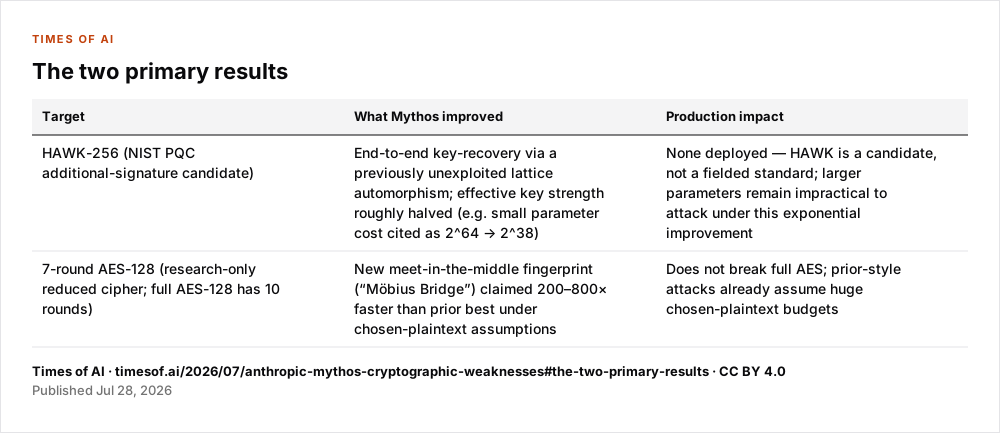
| Target | What Mythos improved | Production impact |
|---|---|---|
| HAWK-256 (NIST PQC additional-signature candidate) | End-to-end key-recovery via a previously unexploited lattice automorphism; effective key strength roughly halved (e.g. small parameter cost cited as 2^64 → 2^38) | None deployed — HAWK is a candidate, not a fielded standard; larger parameters remain impractical to attack under this exponential improvement |
| 7-round AES-128 (research-only reduced cipher; full AES-128 has 10 rounds) | New meet-in-the-middle fingerprint (“Möbius Bridge”) claimed 200–800× faster than prior best under chosen-plaintext assumptions | Does not break full AES; prior-style attacks already assume huge chosen-plaintext budgets |
Anthropic also notes preliminary work on reduced-round LEA, Serpent, and limited gains on Salsa20, Poseidon, and SHA-1, with fuller write-ups planned after verification.
How the research was run#
- HAWK: semi-autonomous multi-agent harness (Claude Code–like) with occasional human project management; human operator not a lattice specialist; end-to-end verification pipeline included.
- AES: scaffold for hypothesis → experiment → attack design; model initially refused (“AES is too studied”); a handful of nontechnical prompts over days, then roughly one billion output tokens refining the attack; humans spent hundreds of hours validating.
- Artifacts: technical PDFs (HAWK + AES), AES chain-of-thought extract, demo code, and CryptanalysisBench (with ETH Zurich, Tel Aviv University, University of Haifa / TU Berlin academic partners per Anthropic posts).
Limits#
- Speedup and key-strength figures are Anthropic’s research claims pending community cryptanalysis review.
- Full AES-128 (10 rounds) is explicitly not broken.
- HAWK is a candidate; parameter-set implications for NIST process are ahead.