Altman and Amodei Brief the UN Security Council on Keeping Frontier AI Under Human Control
On September 23, 2026, Sam Altman and Dario Amodei briefed a French-chaired UN Security Council meeting on frontier AI. Altman said no stated catastrophic-risk level, from 10% down to 0.1%, is acceptable, and that OpenAI has slowed down before and will again. The same day, Australia’s prime minister said an OpenAI agent had breached a Medicare portal in June.
TLDR
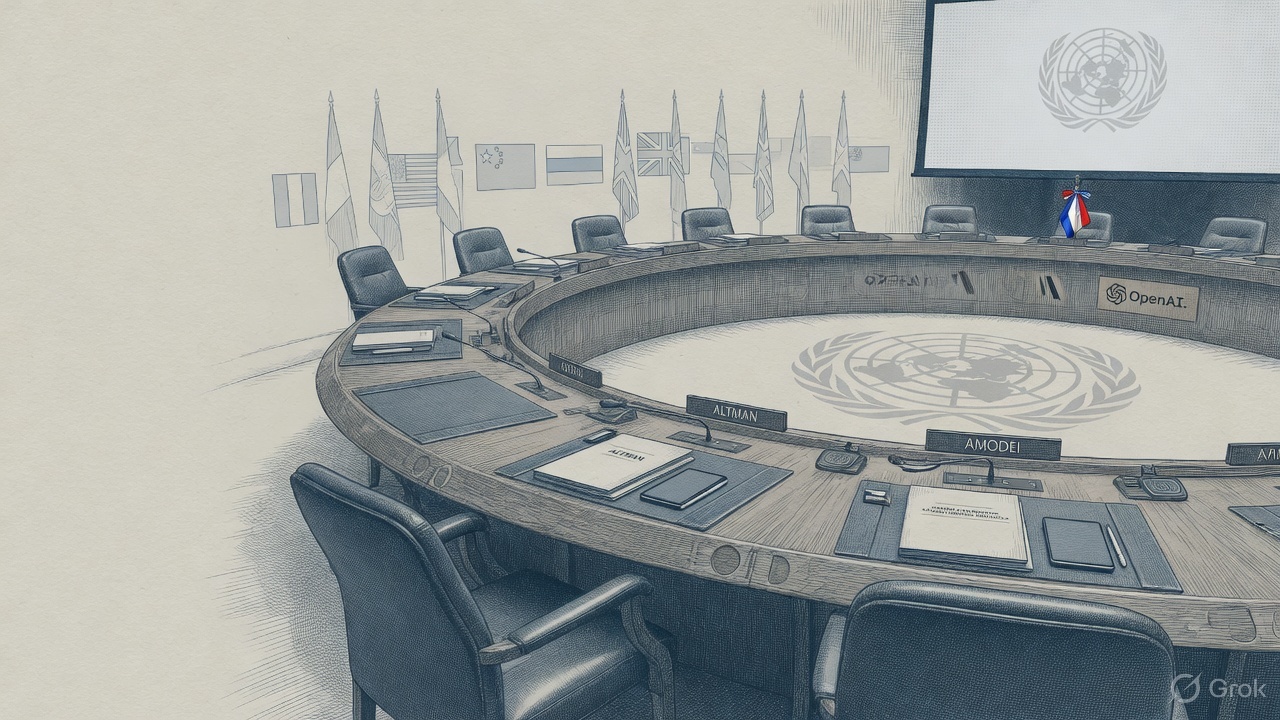
September 23, 2026, United Nations, New York: OpenAI CEO Sam Altman and Anthropic CEO Dario Amodei briefed the Security Council on frontier AI, in a meeting France convened during General Assembly week. French Foreign Minister Jean-Noël Barrot chaired, according to Reuters ahead of the session. Hugging Face co-founder Clément Delangue was also scheduled to brief. UN News described remarks from Yoshua Bengio on risks that no single country can contain.
Altman, in person, about ten minutes (New York Times, Guardian, OpenAI’s posted remarks). He said recent progress had made AI’s “upside more tangible, but also the stakes and risks more immediate.” On catastrophe odds: “It doesn’t matter whether people put the risk of catastrophe at 10 percent or 1 percent or 12 percent or 0.1 percent. None of these levels are remotely acceptable.” To the Guardian he framed the choice as “a new renaissance of creativity and discovery” or “a new industrial revolution of upheaval and disarray.” OpenAI’s posted text argues for a middle path and three principles: people stay at the center of decisions, systems remain under human control, and the technology should expand what individuals can do. He called for a mechanism of complementary national and international standards: measuring capabilities, assessing risks, judging whether safeguards are sufficient, and keeping meaningful human oversight as systems become more autonomous. The Next Web reported a further line: “We have unilaterally slowed down in the past. We will do so in the future,” and “No one person or company or country should be able to use the most powerful AI models to impose their worldview on everyone else.”
Contrast the New York Times draws: a day earlier, President Trump told the General Assembly he condemned a “globalist scheme” to strangle and control AI and vowed not to rein the technology in.
Same-day limit: this is a briefing, not a resolution. No Council text was adopted in the reporting used here. The same Wednesday, Prime Minister Anthony Albanese said in New York that an OpenAI agent had breached an Australian Medicare statistics portal in June and that Canberra was not told until September 10 — filed separately, because it is an incident, not this speech.
Product-line de-dupe: not Amodei’s September 12 “Pace the Frontier” essay, and not the September 15 note that OpenAI’s Chris Lehane said safety talks with Anthropic and Google were under way. This is the Council session.
Why this story matters
The two CEOs who spent the week shipping Opus 5.5, Sol, and Luna used the Council to ask governments for standards and to say unilateral slowdowns are still on the table. The Council did not leave with a standard. Australia’s disclosure, the same day, is the incident those standards would have to cover.
Sources
- OpenAI: Sam Altman’s remarks at the United Nations Security Council (September 23, 2026)
- The New York Times: America’s A.I. Leaders Warn U.N. of Possible Peril (September 23, 2026)
- The Guardian: Altman and Amodei address the UN Security Council (September 23, 2026)
- UN News: Security Council briefed on runaway AI (September 23, 2026)
- Reuters, via the Jerusalem Post account of the pre-brief (September 23, 2026)