Anthropic Says Claude Found a Phage Enzyme System With CRISPR-Like Repeats
On September 23, 2026, Anthropic said a new Bay Area biology group let Claude search DNA for reverse transcriptases and flag a phage system it calls ART: a known jumbo-phage enzyme plus a repeat array and an accessory protein nobody had tied together. About 950 agents ran 21 hours and 210 million tokens. Function is unknown. The lab is BSL-1 and BSL-2, and humans do the bench work.
TLDR
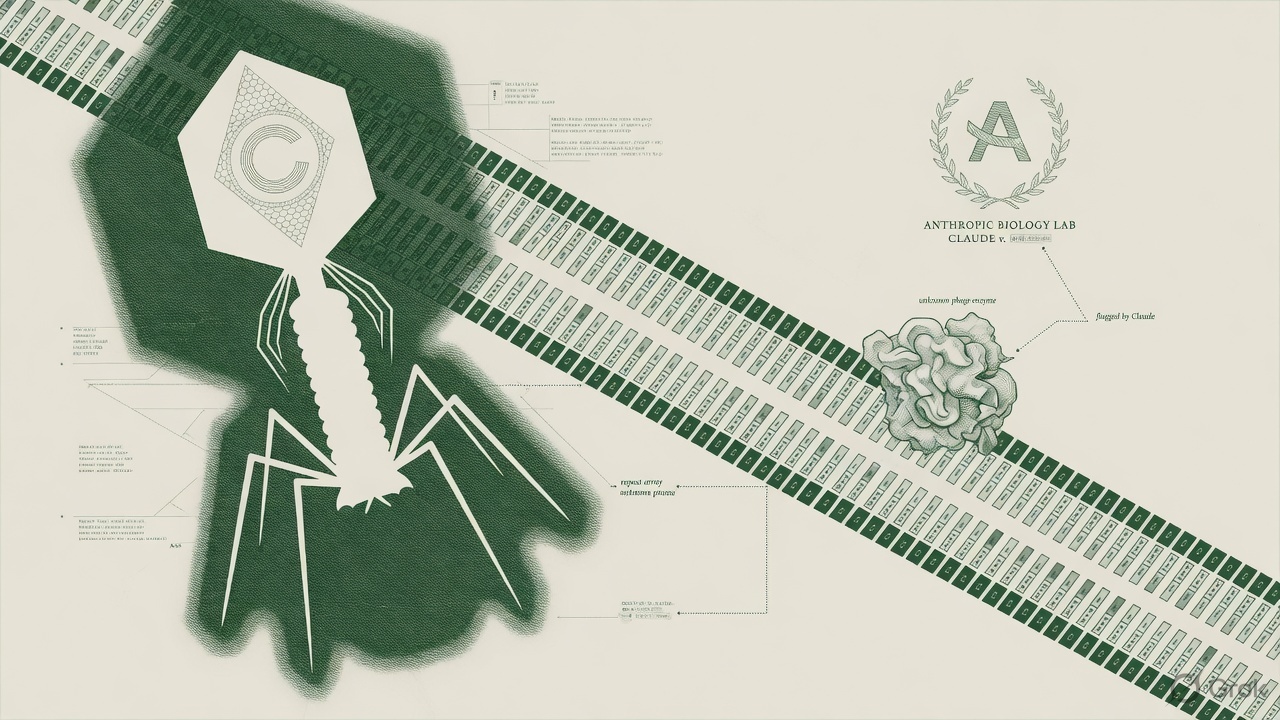
Anthropic, September 23, 2026: a new life-sciences research group and a Bay Area laboratory. The post’s result is early and narrow. Claude, given a prompt to search a large DNA database for interesting reverse transcriptases (enzymes that copy RNA into DNA), flagged a system Anthropic calls array-associated reverse transcriptases (ART).
What was new versus what was already known: the underlying reverse transcriptase, from a jumbo phage, had been identified in earlier studies. Anthropic says Claude appears to be the first to notice the system’s defining features — an associated array of non-coding DNA repeats and an accessory protein of unknown function. The repeat layout resembles a CRISPR array. First experiments show the array is expressed as a set of distinct short RNAs. The primary function is unknown. Anthropic says the combination of traits has only been seen together in a handful of other systems, all of them programmable DNA tools, and it is not claiming ART is one of those tools yet.
Scale, as stated: after the initial prompt, agents combed the database. One search ran about 21 hours, roughly 950 agents, 210 million tokens. Across the program, agents gathered over 200,000 reverse transcriptases, picked out 3,500 candidate systems, and narrowed those to 20 human-readable reports. Anthropic says its scientists’ role was the initial prompt and the lab work.
Lab limits: BSL-1 and BSL-2 only. No human pathogens. All bench work is done by human scientists. The group says it has experimented with the Model Hardware Standard for automating lab work, and that this style of molecular biology is a poor fit for that.
Outside comment in the post: Feng Zhang (MIT and the Broad Institute), after reviewing the preprint: “This is an exciting example of how AI agents can contribute to biological discovery. The identification of RNA-repeat arrays associated with reverse transcriptases is genuinely intriguing and merits further investigation.”
Preprint: anthropic.com PDF.
Product-line de-dupe: not the September 17 Life Sciences Verification Program, which is an access grant. This is a research claim from Anthropic’s own lab.
Why this story matters
The claim is a candidate, not a gene-editing tool. What is concrete is the split of labor: agents did the genome mining, people did the bench, and the function is still open. Zhang’s line is an invitation to check the preprint, not a confirmation that ART works like CRISPR.