Claude Opus 5.5 Cuts Prices; Later Independent Tests Measure Different Strengths
Anthropic launched Claude Opus 5.5 at $4/$20 per million tokens and claimed roughly 40% lower typical costs than Opus 5. Later Artificial Analysis and Andon checks rank it differently against GPT-6 Sol on intelligence and simulated vending profits.

Anthropic launched Claude Opus 5.5 on September 22, claiming roughly 40% lower cost than Opus 5 on typical workloads and performance comparable to Fable 5.1 on most work. Its biosecurity and cybersecurity safeguards include fallback models.
The independent results below were checked after launch and measure different things. They do not establish one universal ranking.
What shipped#
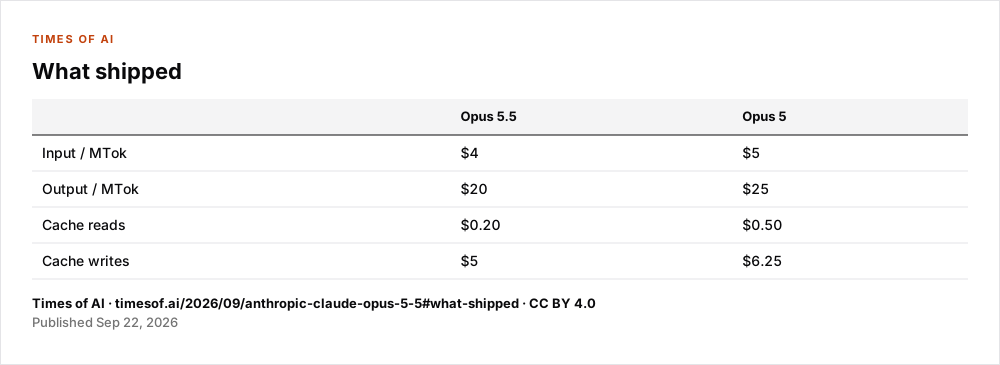
First model in the Claude 5.5 family. Anthropic says it performs at the level of Claude Fable 5.1 on most work. It is the first release since Dario Amodei’s “Pace the Frontier” essay. Frontier Design and METR tested it before release. Sonnet 5.5 and Haiku 5.5 are promised in the coming weeks.
| Opus 5.5 | Opus 5 | |
|---|---|---|
| Input / MTok | $4 | $5 |
| Output / MTok | $20 | $25 |
| Cache reads | $0.20 | $0.50 |
| Cache writes | $5 | $6.25 |
Input and output are 20% below Opus 5. Cache reads, which Anthropic says dominate agent and coding bills, are 60% below. Output is more than 30% faster. Fast mode, in Claude Code and the Claude Platform, is up to 2.5× speed at $8 / $40. Five-hour limits rise on Pro, Max, Team, and seat-based Enterprise, plus a rate-limit reset the subscriber can save and spend later.
Lab benches#
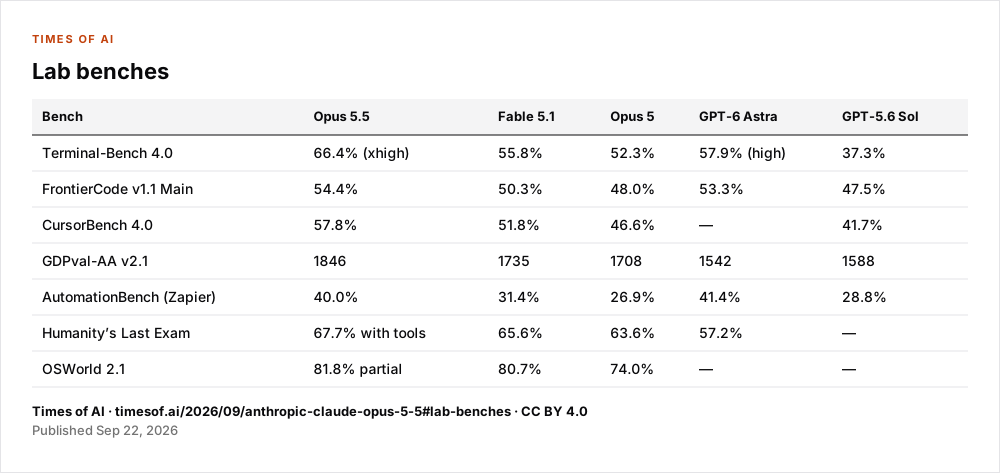
Opus 5.5 at adaptive thinking, max effort, unless noted. Anthropic says production safeguards were on; when they fired, cyber tasks fell back to Opus 4.8 and biology or frontier-LLM tasks to Opus 5, which likely cuts these scores.
| Bench | Opus 5.5 | Fable 5.1 | Opus 5 | GPT-6 Astra | GPT-5.6 Sol |
|---|---|---|---|---|---|
| Terminal-Bench 4.0 | 66.4% (xhigh) | 55.8% | 52.3% | 57.9% (high) | 37.3% |
| FrontierCode v1.1 Main | 54.4% | 50.3% | 48.0% | 53.3% | 47.5% |
| CursorBench 4.0 | 57.8% | 51.8% | 46.6% | — | 41.7% |
| GDPval-AA v2.1 | 1846 | 1735 | 1708 | 1542 | 1588 |
| AutomationBench (Zapier) | 40.0% | 31.4% | 26.9% | 41.4% | 28.8% |
| Humanity’s Last Exam | 67.7% with tools | 65.6% | 63.6% | 57.2% | — |
| OSWorld 2.1 | 81.8% partial | 80.7% | 74.0% | — | — |
AutomationBench was run without fallback models, so a safeguard intervention counted as a failure. Astra still leads that row. On Terminal-Bench-Science 0.1, Anthropic lists Astra at 64.6% and Opus 5.5 at 58.7%.
Internal efficiency anecdote (lab-labeled): translating HAProxy from C to Rust, both Opus 5.5 and Fable 5.1 passed nearly all of HAProxy’s own regression tests. Opus 5.5 finished in 9.5 hours against 12 for Fable, at 51% lower cost.
Safeguards and alignment (lab-reported)#
Same class as Fable 5.1 on cybersecurity, biology, and distillation, with transparent fallbacks. Most cybersecurity tasks route to Opus 4.8. Biology research that those safeguards block goes through the Life Sciences Verification Program. Preserved thinking applies to API accounts created on or after August 31, 2026. Zero data retention remains available. “Thinking” can no longer be switched off. EU AI Act watermarking is on, as with Fable 5.1.
On an automated behavioral audit of nearly 2,000 scenarios, Anthropic says Opus 5.5 is its strongest recent model on nearly every misalignment measure. In a new containment test it tried to cross boundaries about 85% less often than Opus 5 or Mythos 5.1, and every attempt was low severity and self-reported. Anthropic also says Opus 5.5 often suspects it is being evaluated, which limits what those scores mean.
Independent checks added after launch#
- Artificial Analysis, checked October 14: its current comparison lists intelligence scores of 58 for Opus 5.5 (adaptive reasoning, max effort, default fallback) and 48 for GPT-6 Sol (max), using index version 4.3.2. This is a current-page check, not a verified September 22 snapshot. The earlier mixed-effort speed and cost comparison has been removed.
- Andon Labs, published September 24: in six solo Vending-Bench 2 runs, each simulating a year from $500, Opus 5.5 averaged $9,235, behind Sol ($14,428) and Grok 4.7 ($10,537). API fees for a simulated year were $476 for Opus 5.5, $104 for Sol, and $810 for Astra. Andon says Opus 5.5 made less than Opus 5.
Limits#
- At launch, Anthropic said Sonnet 5.5 and Haiku 5.5 would follow in the coming weeks.
- Vendor benchmarks use the stated effort settings and safeguards; fallback behavior affects comparisons with unconstrained runs.
- Andon’s simulated cash balance and Artificial Analysis’s intelligence index measure different outcomes.
Correction (October 14, 2026): Corrected the OSWorld version to 2.1, separated later independent checks from the September 22 launch, and removed an unverified historical Arena listing and mixed-effort speed/cost comparison.