OpenAI Backs an Independent Math Advisory Group Hosted at the Institute for Advanced Study
On September 21, 2026, OpenAI said mathematicians have set up an independent advisory group, hosted at the Institute for Advanced Study, to judge emerging AI math results and how tools should support research. Named members include Timothy Gowers, Martin Hairer, Edward Witten, Ravi Vakil, and Melanie Matchett Wood. The group can publish advice OpenAI did not ask for.
TLDR
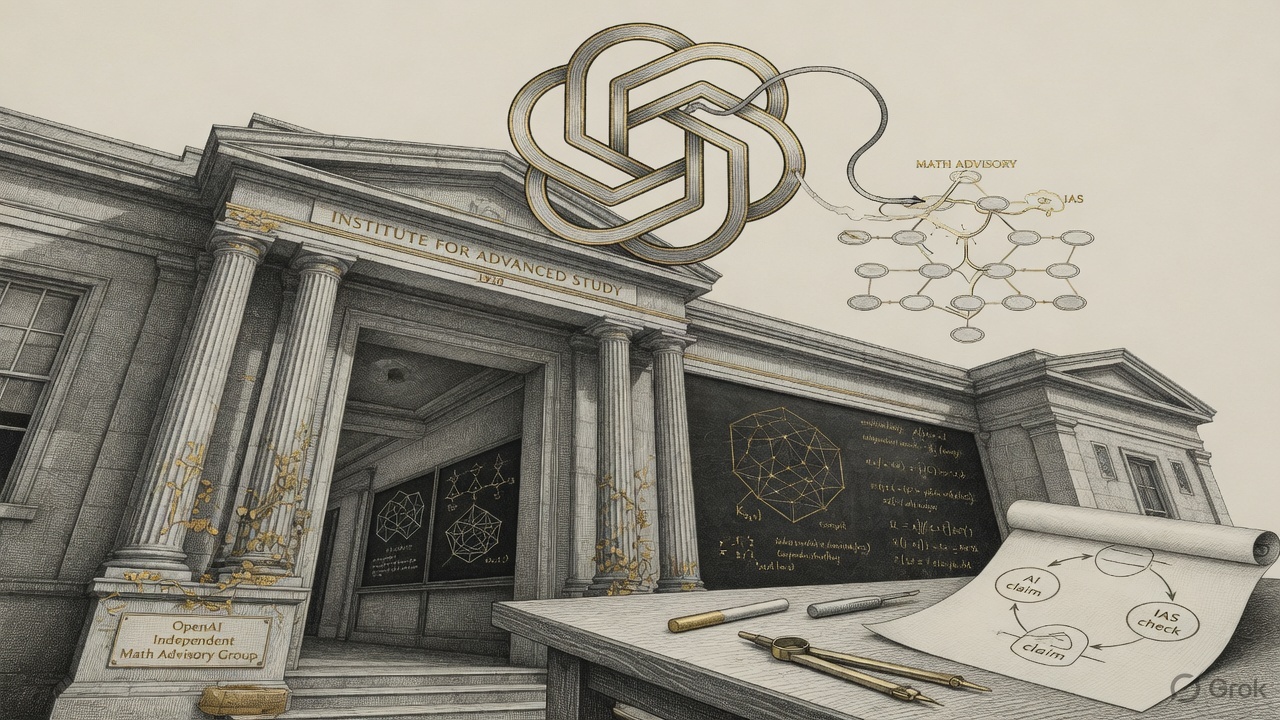
OpenAI, September 21, 2026: mathematicians have established an independent Advisory Group on Mathematics and Artificial Intelligence, hosted at the Institute for Advanced Study. OpenAI says the group is a bridge to the mathematical community after criticism of how AI companies handle math results. It will advise on reviewing and communicating emerging results, on academic standards, and on how OpenAI’s tools can support research and learning.
The group operates independently of OpenAI. It can offer advice that was not requested, comment on OpenAI’s impact on mathematics, and make its advice public.
Initial members, as listed by OpenAI: François Charles (ENS-PSL), Camillo De Lellis (IAS, GSSI), Timothy Gowers (Collège de France, Cambridge), Martin Hairer (EPFL, Imperial College London), Nikhil Srivastava (Berkeley, Simons Institute), Ulrike Tillmann (Oxford, INI), Ravi Vakil (Stanford), Edward Witten (IAS), Melanie Matchett Wood (Harvard).
Limits: this is a charter and a roster, not a first ruling. OpenAI does not publish bylaws, a conflict policy, or a calendar. No new theorem is claimed in the post.
Product-line de-dupe: not the August 1 note on ten math and theoretical-CS results, and not the May Erdős unit-distance disproof. Those are the arguments this group is being stood up to sit beside.
Why this story matters
The names are the story. A Fields-level roster that can publish unsolicited criticism is a different object from a lab blog listing its own proofs. Whether it is used, and whether a result ships without the group, is the next test.