Grok 4.7 Holds Grok 4.6 Prices and Moves the Specialty Benches
xAI shipped Grok 4.7 at the same $2/$6 token prices as Grok 4.6, with a fast variant at 2× speed and 2× price. Lab tables lead EEBench and Harvey’s legal-agent bench; Andon’s Vending-Bench put it in the middle — closer to Opus 5.5 than to Sol.

The price did not drop against Grok 4.6. The movement is on long coding, electrical engineering, and a legal-agent bench where the lab’s own numbers put it ahead of Sol and Fable. The independent cash test a few days later put it in the middle, closer to Opus 5.5 than to Sol.
xAI (September 21): Grok 4.7, which the lab calls its most capable model for coding and knowledge work. It uses a larger base model than Grok 4.6, a longer reinforcement-learning run weighted toward tasks that take many hours, and training to understand the Grok Bot harness natively.
Price and availability#
Starting at $2 per million input tokens and $6 per million output tokens — the same sticker as Grok 4.6. A fast variant serves at twice the output speed and twice the price. The hero line says “twice as fast, at half the price of comparable models.” The body says it is served at the same price and speed as Grok 4.6. Read the half-price claim against peers (GPT-5.6 Sol at $4 / $20, Fable 5.1 at $10 / $50 on the same table), not as a cut versus 4.6.
Where: Cursor, Grok Build, the Grok API, third-party coding harnesses, and model routers and cloud platforms, the day of the post.
Lab table#
xAI’s comparison: Grok 4.7 vs Grok 4.6 / GPT-5.6 Sol / Fable 5.1:
Effort settings differ: xAI generally uses Grok 4.7 at xhigh, Grok 4.6 at high, and competitors at max; the 71.0% DeepSWE result uses high. These settings limit like-for-like comparisons.
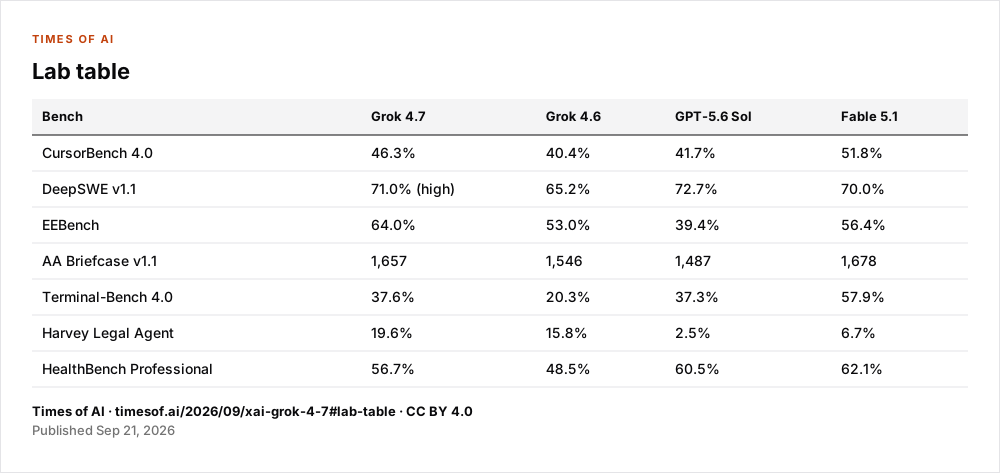
| Bench | Grok 4.7 | Grok 4.6 | GPT-5.6 Sol | Fable 5.1 |
|---|---|---|---|---|
| CursorBench 4.0 | 46.3% | 40.4% | 41.7% | 51.8% |
| DeepSWE v1.1 | 71.0% (high) | 65.2% | 72.7% | 70.0% |
| EEBench | 64.0% | 53.0% | 39.4% | 56.4% |
| AA Briefcase v1.1 | 1,657 | 1,546 | 1,487 | 1,678 |
| Terminal-Bench 4.0 | 37.6% | 20.3% | 37.3% | 57.9% |
| Harvey Legal Agent | 19.6% | 15.8% | 2.5% | 6.7% |
| HealthBench Professional | 56.7% | 48.5% | 60.5% | 62.1% |
Safety, lab-reported: a new safeguard stack. xAI says it tops LatchBio’s biosafety benchmark at 62.4%, and on HackerBench v0.3 lets 3.3% of risky dual-use cyber prompts through while rarely blocking legitimate security work. Select cybersecurity partners get invite-only red-team access.
Independent checks#
- Andon Labs, posted September 24, 2026, ran Vending-Bench 2 (six runs, $500 and one simulated year). Grok 4.7 averaged $10,537. GPT-6 Sol averaged $14,428. Claude Opus 5.5 averaged $9,235. Andon says this is the first time a Grok model beat the newest Claude Opus on that bench, and that Opus 5.5 made less than Opus 5. In the four-game arena among the three, Sol finished well ahead and the other two ended within $200.
Limits#
- Price held flat versus Grok 4.6; “half the price” is a peer comparison.
- This article does not establish an Arena Code Elo or a confirmed Artificial Analysis index score for Grok 4.7.
- Biosafety and HackerBench figures are lab-reported.
Correction and source review — October 14, 2026: Removed an unpreserved historical Arena snapshot and an unverified secondary AA score. No Arena or AA ranking is inferred from their removal; the independent Vending-Bench results remain. Added the differing effort settings used in the vendor benchmark table.