FCC Licenses SpaceX's 1 Million-Satellite Starmind Data-Center Plan; First Is Due by 2033
The Federal Communications Commission's Space Bureau on November 25 granted, in part and with conditions, SpaceX's application to operate Starmind, a constellation of up to 1 million satellites designed as data centers in orbit for AI computing. The order covers backup and emergency radio links, since Starmind will rely on optical links, and defers SpaceX's request to dispose of satellites above 600 km without atmospheric re-entry. SpaceX must have one satellite operating by November 25, 2033, 10% of the constellation by 2035, half by 2038 and all of it by 2040, or the authorization lapses. Amazon, Viasat and the American Astronomical Society had petitioned to deny it.

The licence is real, but the hard parts are still ahead. The Federal Communications Commission has authorized SpaceX to put up to 1 million AI computing satellites in orbit, yet what the order grants is radio spectrum for backup control links and a deployment schedule that asks for a single working satellite seven years from now. The economics of computing in orbit, and the debris questions for the higher shells, are untouched by it.
What the FCC granted#
The Space Bureau's order, DA 26-1273, was adopted and released on November 25. It grants "in part" and defers "in part" SpaceX's January application for the SpaceX Orbital Data Center System, which the company calls Starmind: up to 1,000,000 non-geostationary satellites in shells between 500 and 1,002 km, operating as data centers in low Earth orbit. The bureau says the grant serves the public interest "by permitting SpaceX to pioneer emergent technology that advances American leadership in space and artificial intelligence."
The radio authority itself is narrow. Starmind will rely on optical links, the order notes, so the grant covers Ka-band frequencies only for backup and emergency telemetry, tracking and command, on an unprotected, non-interference basis.
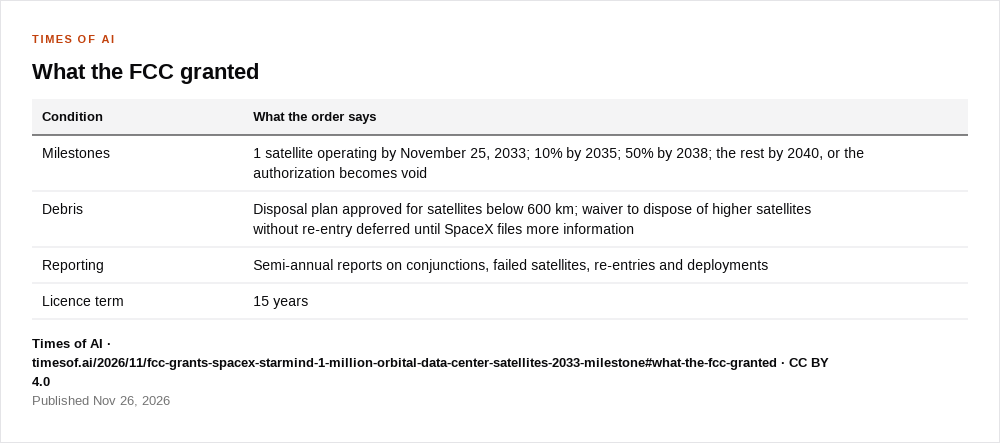
| Condition | What the order says |
|---|---|
| Milestones | 1 satellite operating by November 25, 2033; 10% by 2035; 50% by 2038; the rest by 2040, or the authorization becomes void |
| Debris | Disposal plan approved for satellites below 600 km; waiver to dispose of higher satellites without re-entry deferred until SpaceX files more information |
| Reporting | Semi-annual reports on conjunctions, failed satellites, re-entries and deployments |
| Licence term | 15 years |
SpaceX, the order says, first sought a full waiver of milestone rules and then withdrew it in favour of the FCC's newer schedule, which the bureau applied.
Who objected#
The application drew petitions to deny from Amazon's Kuiper Systems, Viasat and the American Astronomical Society. The bureau dismissed environmental and optical-astronomy concerns as outside its authority and said no further review under the National Environmental Policy Act was required. CNBC reported that Amazon's March petition called Starmind "lofty ambition rather than a real plan" and said it would take SpaceX "centuries" to build; an Earthjustice attorney criticized the approval without environmental review. Chairman Brendan Carr wrote on X that Starmind and competing constellations would use solar power to "extend America's lead in Super Intelligence," CNBC reported, and Elon Musk replied with thanks. SpaceX told the FCC that near-constant solar power would give the satellites "transformative cost and energy efficiency," NBC News reported.
Our read#
Earthbound data centres are running into the grid limits the IEA set out last week, and that is the case SpaceX is making. Nothing in this order tests it. In August, Nvidia said xAI planned to base its first Starmind satellite on a modified Vera Rubin rack, with no launch date; the FCC has now set an outer deadline of 2033 for that first satellite.
Limits#
- The grant is for spectrum, deployment milestones and debris rules. It does not assess Starmind's computing capacity, cost or power claims, which are SpaceX's.
- Before deploying any Starmind satellites that will operate above 600 km, SpaceX must file a modification of this authorization, for FCC approval, containing its final orbital debris mitigation plan. The waiver to skip atmospheric re-entry disposal for those satellites remains deferred.
- Milestone dates are outer limits for keeping the licence, not SpaceX launch plans; SpaceX did not respond to CNBC.
Sources#
- FCC Space Bureau: Memorandum Opinion and Order and Authorization, DA 26-1273, SpaceX Orbital Data Center System (November 25, 2026)
- CNBC: SpaceX wins FCC approval for 1 million orbital data center satellites (November 25, 2026)
- NBC News: SpaceX gets green light to deploy 1 million satellites for data centers in space (November 25, 2026)