OpenAI Says GPT-6.2 Astra Cut Reasoning-Extraction Attacks to 0.2% From 54%
In a November 20 research post, OpenAI said updated safeguards in GPT-6.2 Astra reduced the average success of adaptive attacks that try to recover protected reasoning from an earlier request from 54.0% against GPT-6 Astra to 0.2%, and from 22.9% to 0.9% for the current request. An internal study found students trained on exact reasoning traces gained more cyber capability than those trained on summaries. Weekly enforcement actions have ranged from thousands to tens of thousands of accounts. All figures are OpenAI's own.

OpenAI is recasting distillation from an intellectual-property grievance into a safety problem: a model trained on a frontier model's outputs can learn its skills without inheriting its refusals. In a research post on November 20, the company says new safeguards in GPT-6.2 Astra have made its hidden reasoning far harder to extract, by its own measurements.
The numbers OpenAI reports#
OpenAI ran adaptive black-box red-teaming, in which automated attackers adjust to the system's responses, aggregated across six attacker models.
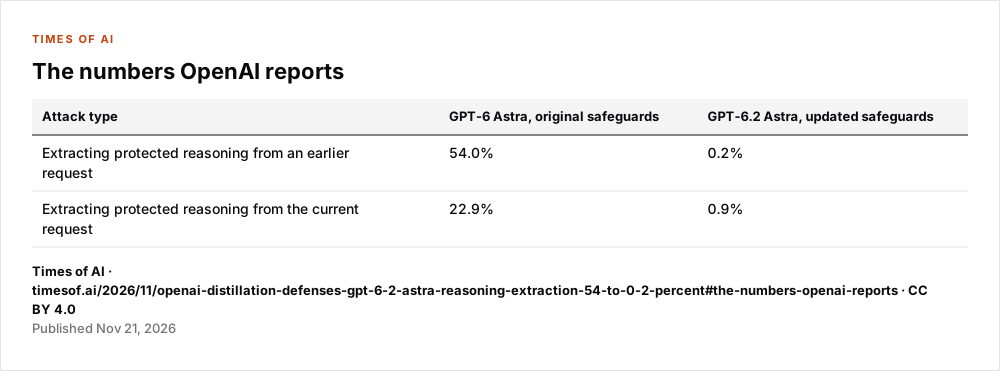
| Attack type | GPT-6 Astra, original safeguards | GPT-6.2 Astra, updated safeguards |
|---|---|---|
| Extracting protected reasoning from an earlier request | 54.0% | 0.2% |
| Extracting protected reasoning from the current request | 22.9% | 0.9% |
OpenAI says the strengthened defences also cover GPT-6.2 Sol, and that it is now applying selected improvements to GPT-6 Astra. The Decoder reports the same figures, sourced to OpenAI.
Why it says reasoning traces matter#
In an internal study, OpenAI trained the same pretrained student model on trajectories from Astra-level teacher models doing coding and defensive cybersecurity tasks. After supervised fine-tuning, the student trained on exact reasoning traces generally outperformed one trained on reasoning summaries; after a round of reinforcement learning, the exact-trace student still scored higher at the largest inference budget tested, while the summary-trained student did better at lower budgets. OpenAI concludes that protecting reasoning traces can limit the transfer of cyber capability even when the original tasks were allowed.
Enforcement and policy#
OpenAI says it has seen multiple unauthorized distillation campaigns on its platform this year, and that its weekly enforcement actions have ranged from thousands to tens of thousands of accounts, with the rate rising significantly this summer. It recalls briefing Congress in February on activity indicating DeepSeek was attempting to distil US frontier models, and its September attribution of a reasoning-extraction campaign to individuals associated with Moonshot AI. It says it plans to share more soon about recent campaigns.
The company says it has told Congress it supports the Chip Security Act, the AI OVERWATCH Act and the MATCH Act, and supports legislation giving the government more tools to sanction foreign actors that illicitly extract capabilities from American models.
Our read: the numbers are a vendor scoring its own patch, with no outside red team named. The more durable claim is the study on reasoning traces, which gives labs a reason to hide chain-of-thought that goes beyond commercial secrecy. Anthropic made a similar case last month when it said its defences cut distillers' harvest by 90 to 99%.
Limits#
- All results come from OpenAI's internal evaluations; the six attacker models are not named, and we found no independent replication.
- OpenAI says it tracks the prevalence of distillation abuse but published no prevalence figures in the post we read.
- The post names no new campaign or attribution; the DeepSeek and Moonshot references are earlier disclosures.