Google's Cogentic Posts Six AI-Written Math Papers; the Lean Proofs Are Still Unreleased
Google Research posted six mathematics papers to its public GitHub repository on November 25 that it says were produced entirely by Cogentic, a multi-agent system running on Gemini 4, with no human interaction beyond the initial prompt. The lead paper claims the first unconditional factoring algorithm in the same L[1/3] class as the number field sieve, though with a constant of 105, so it is a proof result rather than a faster attack. Google says complete Lean 4 formalizations exist but will be released separately; none of the six has been peer reviewed or checked outside Google.

The headline result is a proof, not a speed-up. Google Research's lead paper claims an algorithm that factors any whole number in the same growth class as the number field sieve without relying on any unproven assumption, something the field has lacked for more than three decades. But the guaranteed constant is far too large to threaten encryption, and the evidence that would let outsiders check it quickly, a machine-checkable Lean proof, has not been published.
What Google posted#
Six papers landed in the cogentic_research_papers folder of Google's public google-research repository in a single commit authored at 10:11 UTC on November 25. Each paper's description says the paper "and its Lean 4 formalization were entirely obtained by Cogentic," an agentic framework for mathematical discovery, "using Gemini 4 as the base model," with "no human interaction other than the initial prompt." The harness was built by seven researchers at Google Research and Google DeepMind, the descriptions say. The folder now lists ten Cogentic papers; the four earlier ones are dated October 30 to November 23.
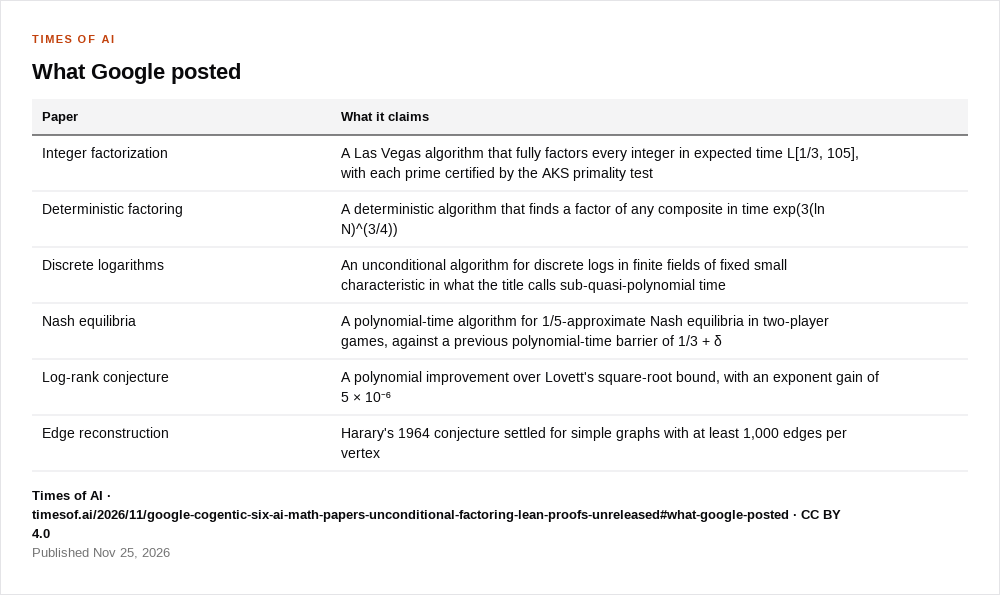
| Paper | What it claims |
|---|---|
| Integer factorization | A Las Vegas algorithm that fully factors every integer in expected time L[1/3, 105], with each prime certified by the AKS primality test |
| Deterministic factoring | A deterministic algorithm that finds a factor of any composite in time exp(3(ln N)^(3/4)) |
| Discrete logarithms | An unconditional algorithm for discrete logs in finite fields of fixed small characteristic in what the title calls sub-quasi-polynomial time |
| Nash equilibria | A polynomial-time algorithm for 1/5-approximate Nash equilibria in two-player games, against a previous polynomial-time barrier of 1/3 + δ |
| Log-rank conjecture | A polynomial improvement over Lovett's square-root bound, with an exponent gain of 5 × 10⁻⁶ |
| Edge reconstruction | Harary's 1964 conjecture settled for simple graphs with at least 1,000 edges per vertex |
The factoring claim, read carefully#
The factoring paper says it improves on the rigorous L[1/2, 1] bound that Lenstra and Pomerance proved in 1992 and matches the exponent of the General Number Field Sieve, whose L[1/3, (64/9)^(1/3)] running time rests on unproven heuristics. That sieve constant is about 1.92 by our arithmetic; the paper's guarantee is 105. OfficeChai, which read the papers, makes the same point: this is "not a faster way to crack real encryption keys." The deterministic and discrete-logarithm papers also touch problems tied to cryptography, but Google does not claim any practical attack.
Claims, and what would check them#
Everything above is Google's description of its own system's output. Each paper says a complete, Mathlib-only Lean 4 formalization "has also been completed and will be released in a companion submission," and Google gives no date. The folder carries the repository's standard line, "This is not an official Google product." We found no Google blog post or press release accompanying the commit.
That gap matters more than usual. When Levent Alpöge's Claude-assisted Riemann proof appeared, the Lean library was public and outside reviewers could compile it; the confidence came from that check, not from the lab. Google DeepMind's Gemini 4 quantum-circuit results the day before came with released Lean files that an outside group recomputed. Cogentic's six papers are, for now, PDFs.
Our read: the autonomy claim, a single prompt in and a formalized paper out, is the stronger and less checkable half of this. It describes a process nobody outside Google observed, while the Lean files, once released, can confirm the theorems but not how they were produced.
Limits#
- None of the six papers has been peer reviewed, and the Lean formalizations Google says exist are not public.
- The "no human interaction" description comes from Google; we have no independent record of the process.
- We read the repository descriptions in full and the first pages of the factoring paper, not all six papers; we have not assessed the proofs.
- The 1.92 figure is our arithmetic from the constant the paper itself cites.
Sources#
- Google Research on GitHub: Cogentic Research Papers index (November 25, 2026)
- Google Research on GitHub: commit adding six Cogentic papers (November 25, 2026)
- Google Research on GitHub: Unconditional Integer Factorization in Time L_N[1/3, O(1)] (paper and description, November 25, 2026)
- Google Research on GitHub: Unconditional Deterministic Subexponential Integer Factoring (November 25, 2026)
- Google Research on GitHub: Discrete Logarithms in Finite Fields of Fixed Characteristic (November 25, 2026)
- Google Research on GitHub: 1/5-Approximate Nash Equilibria in Bimatrix Games (November 25, 2026)
- Google Research on GitHub: Breaking the Square-Root Barrier for the Log-Rank Conjecture (November 25, 2026)
- Google Research on GitHub: Unconditional Edge Reconstruction of Simple Graphs of Linear Density (November 25, 2026)
- OfficeChai: Google's Cogentic AI Releases Six Math Papers In One Day (November 25, 2026)