Sber Puts 708B GigaChat 4 Under MIT; Its Own Scores Trail GLM-5.3
Sber's GigaChat team published GigaChat 4 on Hugging Face on November 26: a mixture-of-experts model with 708 billion total and 41 billion active parameters, a one-million-token context and instant and reasoning modes in one checkpoint, under the MIT licence, with base and intermediate checkpoints included. Sber's model card reports 80.89% on SWE-bench Verified and 71.26% on Terminal-Bench 2.0, below Z.ai's GLM-5.3 on both in the same table. The scores are Sber's own and have not been independently checked. A 37-billion-parameter sibling released alongside it uses a non-commercial licence for individuals.

Russia now has an open-weight model in the same size class as the leading Chinese releases, and Sber has released it under MIT, one of the most permissive licences in use. GigaChat 4, published by Sber's GigaChat team on Hugging Face on November 26, has 708 billion parameters, about 41 billion of them active per token, and ships under the MIT licence. Sber's own benchmark tables are the useful check: on most coding and agent tests they put it behind Z.ai's GLM-5.3, not ahead.
What Sber released#
The model card lists the instruction-tuned model in FP8, BF16 and GGUF formats, a base model, and a separate repository of intermediate training checkpoints. It is a mixture-of-experts design that mixes linear-attention layers with DeepSeek Sparse Attention, supports a context of about one million tokens, and offers an instant mode and a reasoning mode that callers switch per request in a single checkpoint; GigaChat 3.5 split them into separate models. Sber's technical report says the model succeeds the 432-billion-parameter GigaChat 3.5 and lists a pre-training data target of about 20 trillion tokens. The card's deployment recipe runs the FP8 model on two nodes of eight Nvidia H100 80GB GPUs each.
A Russian-language post on Habr from the team says a second model, with 37 billion parameters, came out alongside it. That model's Hugging Face card carries a non-commercial licence for individuals, not MIT.
What the numbers say, and who measured them#
All scores below come from Sber's model card, run with its own harness and a seven-hour timeout on agentic tasks.
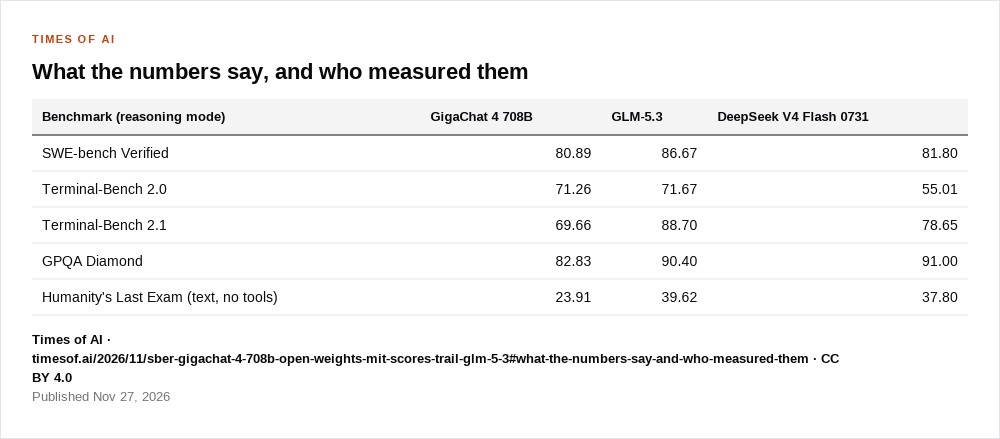
| Benchmark (reasoning mode) | GigaChat 4 708B | GLM-5.3 | DeepSeek V4 Flash 0731 |
|---|---|---|---|
| SWE-bench Verified | 80.89 | 86.67 | 81.80 |
| Terminal-Bench 2.0 | 71.26 | 71.67 | 55.01 |
| Terminal-Bench 2.1 | 69.66 | 88.70 | 78.65 |
| GPQA Diamond | 82.83 | 90.40 | 91.00 |
| Humanity's Last Exam (text, no tools) | 23.91 | 39.62 | 37.80 |
Source: GigaChat 4 model card. Competitor figures are as Sber lists them; we have not matched them to those labs' own reports.
The same card shows the new model ahead on some instruction-following and tool-calling tests, such as BFCL v4, and far ahead of GigaChat 3.5, which scored 64.70% on SWE-bench Verified and 30.30% on Terminal-Bench 2.0. The team's Habr post says that, by its estimates, the 708B model is comparable to GLM 5.3, DeepSeek-V4.1-Flash and Mistral Large 4.
Our read: the size and licence are the news, not a new state of the art. The models Sber chose to compare against are mostly Chinese open releases, the same group that includes Z.ai's GLM-5.4, whose weights arrived on November 23, and Sber's own tables place GigaChat 4 within that group rather than above it. Because the weights and intermediate checkpoints are public, outside testers can now check those numbers.
Limits#
- Every score here is Sber's, under its own evaluation setup; we found no independent leaderboard result for GigaChat 4.
- Competitor scores in Sber's table may use different settings from those labs' own reports, so the comparison is not exact.
- We read the technical report's abstract and model table, not the full report.
Sources#
- Sber (ai-sage) on Hugging Face: GigaChat4-708B-A41B model card (November 26, 2026)
- Sber (ai-sage) on Hugging Face: GigaChat4-37B-A4B model card (November 26, 2026)
- GigaChat: GigaChat 4 Technical Report (November 26, 2026)
- Sber on Habr: GigaChat 4: new agentic skills and the first million (November 26, 2026, in Russian)