Ant Ling's Open 560B Medical Model Tops Some of Its Own Charts, and Is Barred From Clinics
Ant Group's Ant Ling team released LingSante-3.1-flash on November 22, an open-weight medical mixture-of-experts model with 560 billion total and 25 billion active parameters, under an MIT licence. On Ant Ling's own benchmark chart it scores 65.72 on HealthBench Professional against 64.18 for GPT-6 Astra, but 57.27 on MedXpertQA-Text against 71.35 for Gemini 4 Argon, and 57 on PhysicianBench against Argon's 58. The model card says it is for research and evaluation only, is not a medical device and must not be used to diagnose, prescribe or treat. No independent evaluation has been published.

Ant Group's newest open medical model comes with its own warning label. Ant Ling, the model team at China's Ant Group, released LingSante-3.1-flash on November 22, announcing it on X at 15:22 UTC. It is a mixture-of-experts model with 560 billion total parameters and 25 billion active per token, built on Ant Ling's general Ling-3.1-flash and published under an MIT licence on Hugging Face and ModelScope.
Its model card is blunt about what it is not: LingSante-3.1-flash "is intended for research and evaluation. It is not a medical device and must not be used as an independent basis for diagnosis, prescriptions, or treatment." That sets the right frame for the benchmark chart that comes with it.
What shipped#
- Scale and licence. 560B total and 25B active parameters, MIT licence, weights on Hugging Face and ModelScope, with an MXFP4 quantized build also published.
- Aim. Ant Ling says the model combines medical reasoning, professional healthcare communication, evidence research and long, multi-step medical tasks, while keeping general abilities such as coding, search and tool use.
- Context window. The card says the model supports a 1-million-token context; the published
config.jsonsetsmax_position_embeddingsto 262,144. The card does not explain the difference. - Predecessor. The card names Ling-3.0-flash-Sante, with 124 billion total parameters, as Ant Ling's previous healthcare release.
Claims and checks#
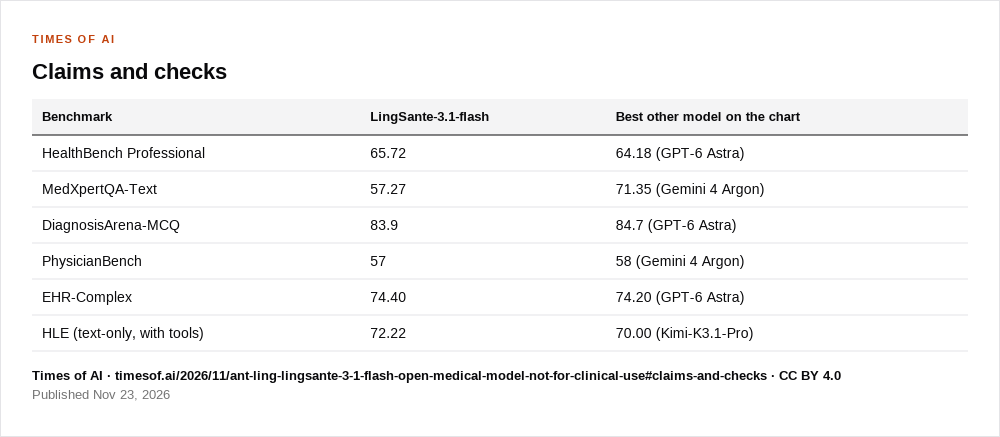
Ant Ling's benchmark chart compares LingSante-3.1-flash with DeepSeek-V4.1-Flash, GLM-5.3, Kimi-K3.1-Pro, Claude Opus 5.5, GPT-6 Astra and Gemini 4 Argon across 16 tests. Selected results, read from the chart:
| Benchmark | LingSante-3.1-flash | Best other model on the chart |
|---|---|---|
| HealthBench Professional | 65.72 | 64.18 (GPT-6 Astra) |
| MedXpertQA-Text | 57.27 | 71.35 (Gemini 4 Argon) |
| DiagnosisArena-MCQ | 83.9 | 84.7 (GPT-6 Astra) |
| PhysicianBench | 57 | 58 (Gemini 4 Argon) |
| EHR-Complex | 74.40 | 74.20 (GPT-6 Astra) |
| HLE (text-only, with tools) | 72.22 | 70.00 (Kimi-K3.1-Pro) |
Four of the 16 tests sit under a heading the chart labels "Internal Benchmarks," which outsiders cannot run. The card also says the model ranks second to GPT-6 Astra on its medical professional-behaviour benchmarks. Every figure is Ant Ling's own; we found no independent evaluation, and we did not check public leaderboards.
The card's caveats go further than most launch posts: it says benchmark and simulated-environment results "do not establish clinical effectiveness," that outputs may be incorrect or unsupported by cited evidence, and that long context "does not guarantee complete retrieval of every relevant fact."
Our read: on Ant Ling's own numbers this is a strong open model on several medical tests, not a sweep, and the developer itself says nothing here shows it is safe for care. Hospitals evaluating it would be starting from vendor charts. OpenAI's recent healthcare push, by contrast, came with its own reviewer-rated safety figures, which were also self-reported.
Context#
The base model has already drawn scrutiny of a different kind: Ling-3.1-flash was one of six Chinese open-weight models that one analyst argued were initialized on Nvidia Blackwell-class chips, which need a US licence for export to China. That analysis does not establish where the chips were or whether export rules were broken, and it does not concern LingSante's medical training.
Limits#
- All benchmark results are Ant Ling's, read from its launch chart; we did not reproduce them, and some tests are internal.
- The 1M-token context claim and the 262,144-token configuration value conflict; we report both.
- We describe the training only at the level of Ant Ling's own summary and do not assess the medical data it used.